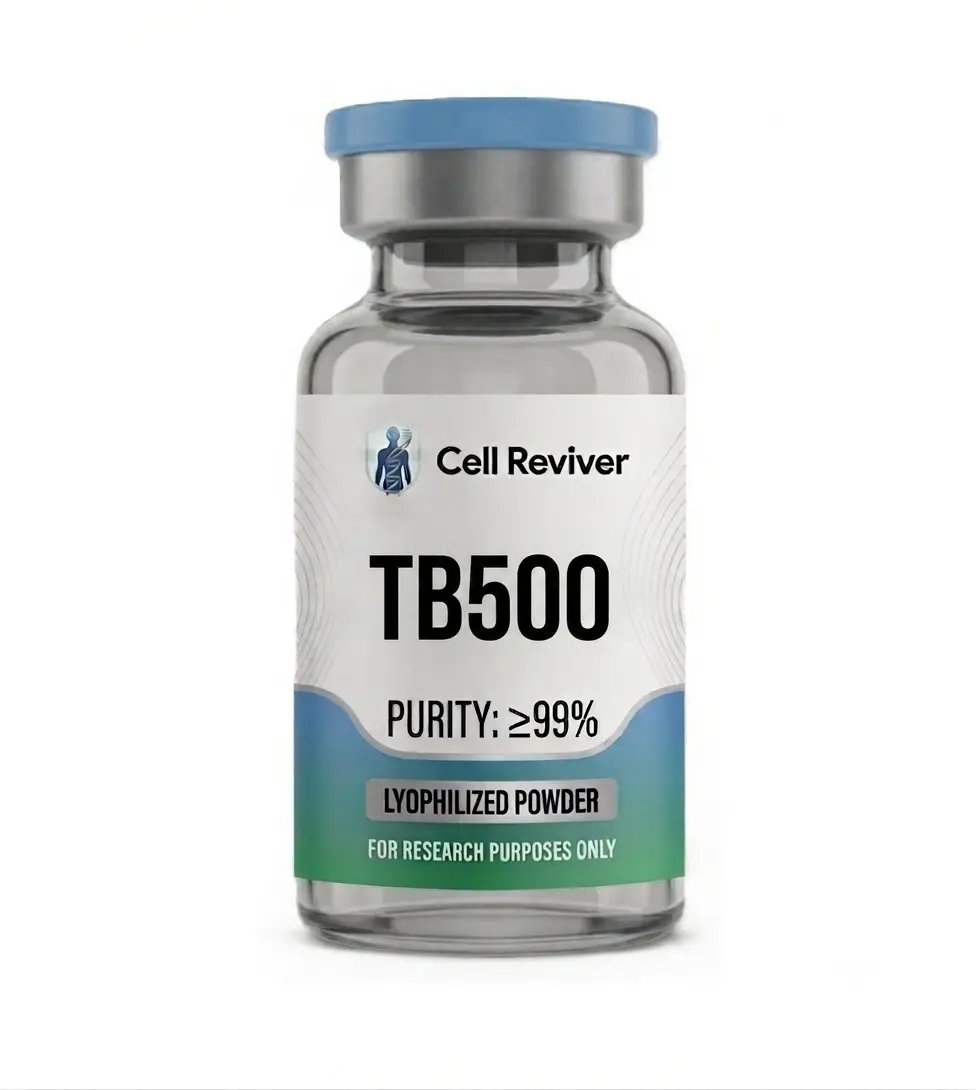
TB500 Research Information
Thymosin Beta-4
Tissue Repair & Wound Healing Research
Important: This information is for educational and research purposes only. Always consult with a qualified healthcare professional before use.
Contents
What is TB500?
TB500 is a synthetic peptide derived from Thymosin Beta-4, a naturally occurring peptide found in human cells. It consists of 43 amino acids and plays a crucial role in cell migration, angiogenesis, and tissue repair. Unlike many peptides that target specific receptors, TB500 acts through multiple pathways to promote healing and reduce inflammation.
TB500 is available in freeze-dried vial formulations for research purposes.
How TB500 Works
TB500 exerts its effects through multiple mechanisms:
Cell Migration
Promotes endothelial cell migration and tissue regeneration
Angiogenesis
Stimulates blood vessel formation and tissue oxygenation
Anti-Inflammatory
Reduces inflammation and modulates immune response
TB500 also supports actin binding, which is essential for cell structure and movement, further enhancing its tissue repair properties.
Research Applications
Wound Healing
Accelerates wound closure and tissue regeneration
Muscle Repair
Promotes muscle healing and reduces recovery time
Joint & Ligament
Supports tendon and ligament repair
Cardiovascular
Investigating effects on heart tissue repair and angiogenesis
Clinical Studies
TB500 has been studied in various research settings:
- Wound Healing Studies: Demonstrated accelerated wound closure and improved tissue regeneration
- Muscle Injury Research: Showed reduced recovery time and improved muscle healing
- Angiogenesis Research: Confirmed role in blood vessel formation and tissue oxygenation
- Inflammatory Studies: Demonstrated anti-inflammatory effects in various tissue types
Interactive Dosing Guide
Select your pen size and dose to see the corresponding volume, clicks, dosing frequency, and how many doses per pen:
Step 1: Select Your Pen Size
Step 2: Select Your Dose
Pen Size
10mg Pen
Selected Dose
1 mg
Doses per Pen
10 doses
Pen Clicks
30 clicks
Volume
0.30 mL
Protocol Level
Level 1
Recommended Schedule
Once weekly - Loading Phase (Weeks 1-4)
Do not change your dose unless advised by a qualified professional.
Protocol Level Summary
| Protocol Level | Target Dose | Frequency | Clicks | Who It's For |
|---|---|---|---|---|
| Level 1 | 1 mg | Once weekly | 30 clicks | New users, weeks 1-4 |
| Level 2 | 2 mg | Once weekly | 60 clicks | Weeks 5-8 |
| Level 3 | 3 mg | Once weekly | 90 clicks | Weeks 9-12 |
| Level 4 | 4 mg | Once weekly | 120 clicks | Experienced researchers |
| Level 5 | 5 mg | Once weekly | 150 clicks | Maximum recommended |
| Level 6 | 10 mg | Once weekly | 300 clicks | Maximum dose tested |
Do not change your dose unless advised by a qualified professional.
Vial Users (Insulin Syringe)
Add 3mL of bacteriostatic water to your freeze-dried vial and mix gently. After reconstitution, use the table below to draw your dose:
Vial Size
10mg vial with 3mL bac water
| Dose | Units on Syringe | Volume (mL) | Protocol Level |
|---|---|---|---|
| 1 mg | 30 units | 0.30 mL | Level 1 |
| 2 mg | 60 units | 0.60 mL | Level 2 |
| 3 mg | 90 units | 0.90 mL | Level 3 |
| 4 mg | 120 units | 1.20 mL | Level 4 |
| 5 mg | 150 units | 1.50 mL | Level 5 |
| 10 mg | 300 units | 3.00 mL | Level 6 |
Always use a new sterile needle and syringe for each injection.
Safety & Precautions
Do not use if you:
- Are allergic to TB500 or any ingredients
- Are pregnant or breastfeeding
- Have active cancer or uncontrolled cell growth conditions
Common side effects:
- Injection site reactions (redness, swelling, pain)
- Headache
- Flushing
- Mild nausea
Warning: If you experience severe allergic reactions (hives, difficulty breathing, swelling of face/lips/tongue) or signs of infection, seek immediate medical help.
References
- Goldstein AL, et al. "Thymosin Beta-4: A Multifunctional Peptide with Diverse Roles in Cell Migration and Tissue Repair." Expert Opinion on Biological Therapy. 2018.
- Malinda KM, et al. "Thymosin Beta-4 Accelerates Wound Healing." FASEB Journal. 1999.
- Crocker SJ, et al. "Thymosin Beta-4 and Angiogenesis." Annals of the New York Academy of Sciences. 2007.
This information is for educational and research purposes only. Always consult with a qualified healthcare professional.
Last updated: August 2026