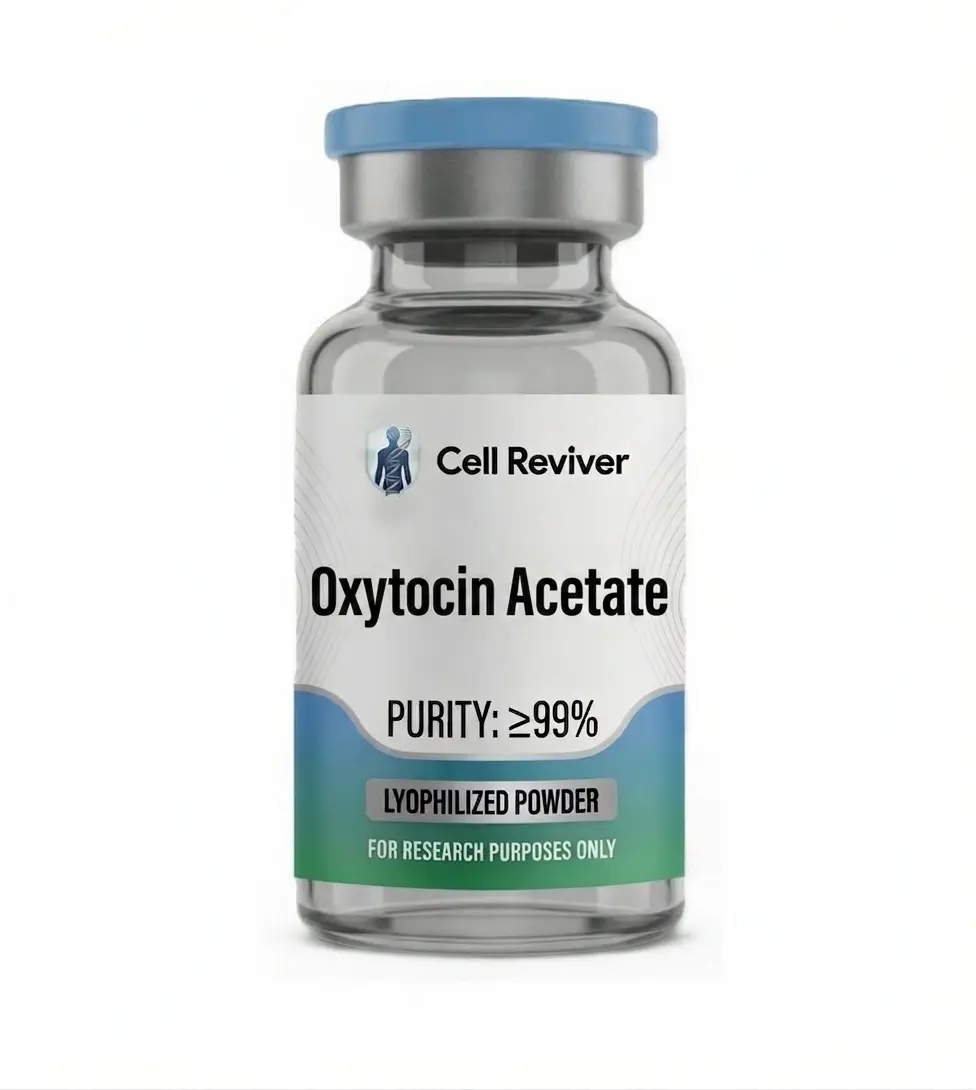
Oxytocin Acetate Research Information
Neuropeptide Hormone
For Social & Neuroendocrine Research
️ Important: This information is for educational and research purposes only. Always consult with a qualified healthcare professional before use.
Contents
What is Oxytocin Acetate?
Oxytocin Acetate is a synthetic form of the naturally occurring neuropeptide hormone oxytocin that consists of 9 amino acids (Cys-Tyr-Ile-Gln-Asn-Cys-Pro-Leu-Gly-NH2) with a disulfide bridge between the two cysteine residues. It was the first peptide hormone to be synthesized and has been extensively studied for its diverse physiological and behavioral effects.
Oxytocin is produced in the hypothalamus and released by the posterior pituitary gland, playing critical roles in social bonding, reproduction, childbirth, and lactation. Oxytocin is available in pen and freeze-dried vial formulations for research purposes.
How Oxytocin Acetate Works
Oxytocin works through multiple mechanisms to influence physiology and behavior:
Receptor Binding
Binds to oxytocin receptors (OXTR) in the brain and peripheral tissues
Social Behavior
Modulates social bonding, trust, empathy, and emotional processing
Reproductive Function
Regulates uterine contractions, milk ejection, and reproductive behaviors
Oxytocin has a short half-life of approximately 3-5 minutes in plasma and is rapidly cleared by the liver and kidneys.
Research Applications
Social Neuroscience
Studying social bonding, trust, and emotional processing
Reproductive Research
Investigating parturition, lactation, and maternal behaviors
Psychiatric Research
Studying autism, anxiety, and social cognition disorders
Cardiovascular Research
Investigating oxytocin's effects on blood pressure and cardiac function
Clinical Studies
Social Behavior & Bonding
- Intranasal oxytocin has been shown to increase trust and cooperation in social interactions
- Modulates fear response and enhances social cognition
- Plays a role in pair bonding and attachment behaviors
Reproductive Function
- Oxytocin is essential for uterine contractions during labor
- Stimulates milk ejection during lactation
- Regulates maternal behaviors and bonding
Key Research Findings
- Oxytocin has a short half-life of 3-5 minutes in plasma
- Crosses the blood-brain barrier in limited amounts
- Demonstrates sexual dimorphism in its effects
Interactive Dosing Guide
Select your vial size and dose to see the corresponding volume, clicks, dosing frequency, and how many doses per vial:
️ Step 1: Select Your Vial Size
Step 2: Select Your Dose
Common research protocols: 0.01-0.2 mg per dose. Clinical studies use up to 0.5-1 mg for research purposes.
Vial Size
10mg Vial
Selected Dose
0.05 mg
Doses per Vial
200 doses
Pen Clicks
15 clicks
Volume
0.15 mL
Protocol Level
Level 2 (Standard)
Recommended Schedule
As needed - Research Protocol
️ Do not change your dose unless advised by a qualified professional.
Protocol Level Summary
Based on research protocols: 0.01-0.2 mg per dose.
| Protocol Level | Target Dose | Frequency | Pen Clicks | Volume (mL) | Who It\'s For |
|---|---|---|---|---|---|
| Level 1 (Starting) | 0.01-0.02 mg | As needed | 3-6 clicks | 0.03-0.06 mL | New users, first 2 weeks |
| Level 2 (Standard) | 0.05 mg | As needed | 15 clicks | 0.15 mL | After 2 weeks, maintenance |
| Level 3 (Advanced) | 0.1 mg | As needed | 30 clicks | 0.30 mL | If more response needed |
| Level 4 (Maximum) | 0.2 mg | As needed | 60 clicks | 0.60 mL | Experienced users only |
️ Do not change your dose unless advised by a qualified professional.
Vial Users (Insulin Syringe)
Add 3mL of bacteriostatic water to your freeze-dried vial and mix gently. After reconstitution, use the table below to draw your dose:
Vial Size
10mg vial with 3mL bac water
| Dose | Frequency | Units on Syringe | Volume (mL) | Protocol Level |
|---|
️ Always use a new sterile needle and syringe for each injection.
️ Safety & Precautions
Oxytocin has a well-established safety profile in clinical use. Adverse events are generally mild and dose-dependent.
- Injection site reactions: Mild redness or tenderness at injection site
- Mild gastrointestinal effects: Rare and usually mild
- Uterine contractions: Dose-dependent effect (contraindicated in pregnancy)
Important Safety Considerations:
- Oxytocin is not FDA-approved for psychiatric or social indications
- Do not use if allergic to oxytocin or any ingredients
- Do not use if pregnant or breastfeeding
️ Warning: Oxytocin can cause uterine contractions. Do not use during pregnancy. If you experience severe allergic reactions, difficulty breathing, or signs of anaphylaxis, seek immediate medical help.
References
- Oxytocin Research Overview. Peptide Sciences.
- Oxytocin Technical Guide. Benchchem.
- Oxytocin: A Neuropeptide Hormone. Journal of Peptide Research.
This information is for educational and research purposes only. Always consult with a qualified healthcare professional.
Last updated: July 2026