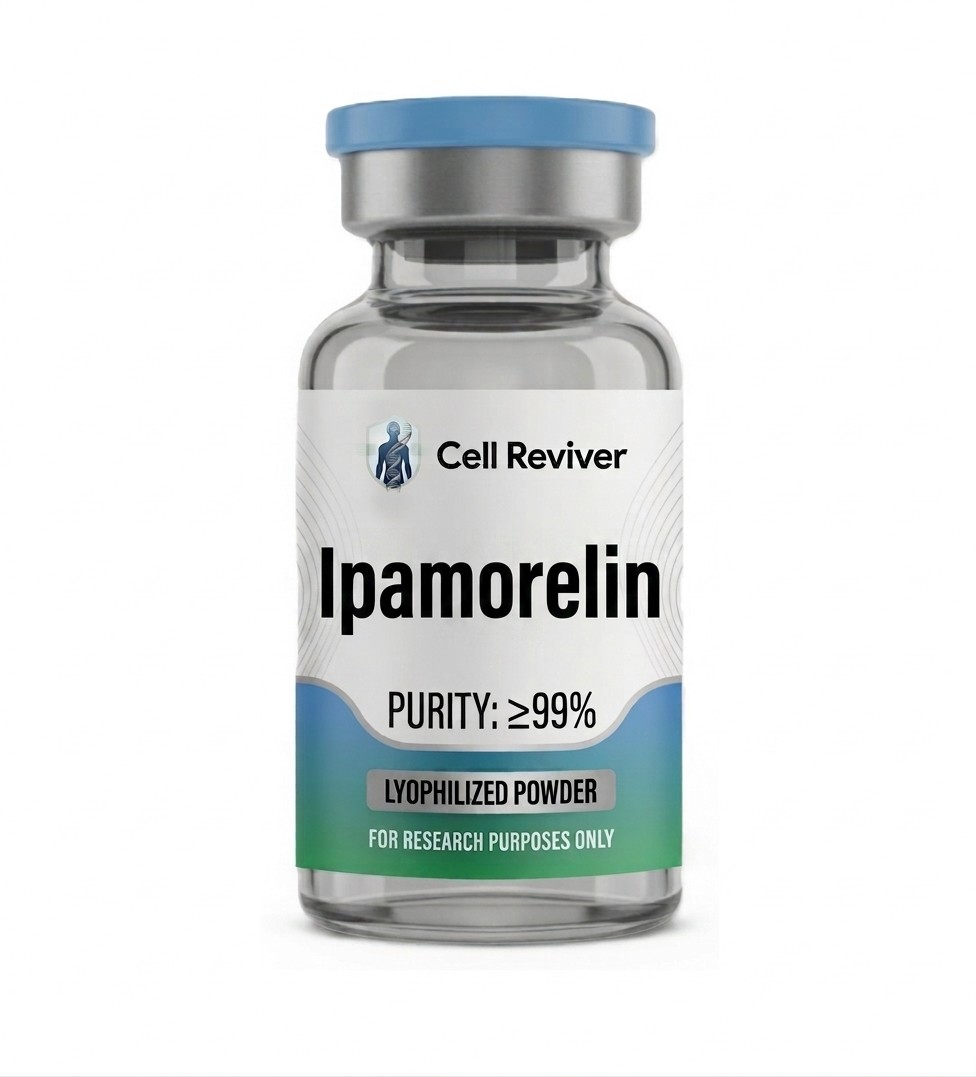
Ipamorelin Research Information
Growth Hormone Secretagogue
For Pulsatile Growth Hormone Research
️ Important: This information is for educational and research purposes only. Always consult with a qualified healthcare professional before use.
Contents
What is Ipamorelin?
Ipamorelin is a synthetic 5-amino acid peptide (Aib-His-D-2-Nal-D-Phe-Lys-NH2) that acts as a potent and selective growth hormone secretagogue receptor (GHSR) agonist. It was developed as a second-generation growth hormone-releasing peptide (GHRP) to mimic the action of ghrelin, stimulating the pituitary gland to release natural growth hormone in a pulsatile manner.
Compared to earlier GHRPs, Ipamorelin offers a more favorable profile, as it triggers a clean GH pulse with minimal elevation of cortisol, prolactin, or ACTH. Ipamorelin is available in pen and freeze-dried vial formulations for research purposes.
How Ipamorelin Works
Ipamorelin works through a targeted mechanism to stimulate natural growth hormone release:
GHSR Agonist
Binds to growth hormone secretagogue receptor (GHSR) on pituitary somatotroph cells
Pulsatile GH Release
Stimulates natural pulsatile growth hormone secretion pattern
Selective Profile
Minimal cortisol, prolactin, or ACTH elevation compared to other GHRPs
Ipamorelin can be administered alone or in combination with a GHRH analog (such as CJC-1295 or Sermorelin) for enhanced synergistic GH release.
Research Applications
Growth Hormone Research
Studying pulsatile GH secretion and IGF-1 elevation
Muscle & Recovery
Researching muscle growth, recovery, and protein synthesis
Metabolic Research
Investigating lipolysis, fat metabolism, and energy balance
Combination Research
Synergistic effects with GHRH analogs (CJC-1295, Sermorelin)
Clinical Studies
Clinical Trial (Faccioli et al., 2025)
- Ten women (mean age 33.9 years) with abnormal sleep patterns and low serum IGF-1 (< 200 ng/mL) were included
- After administration of 100 mcg of Ipamorelin subcutaneously, measured by a specific and validated LC-MS/MS method
- A typical GHS (growth hormone secretagogue) effect was detected
- In two subjects, administration resulted in growth hormone concentrations above 35 ng/mL, reaching 38.3 ng/mL, and stable GH levels were maintained over hours
- Women with low IGF-1 and high body mass index (BMI) were more likely to respond to Ipamorelin
Phase 1 Clinical Trial (Connexios 2009)
- Ipamorelin was evaluated in a Phase 1 clinical trial in 2009 for potential use as a growth hormone secretagogue
- The study established its safety profile and GH-releasing properties in humans
- Results demonstrated that Ipamorelin effectively stimulates GH release
- The trial was discontinued after Phase 1, likely for strategic reasons rather than safety concerns
Combination Therapy (Journal of Urology 2016)
- A retrospective review of 14 men on combination GHRP/SERM therapy (100 mcg each, 3 times daily) showed significant IGF-1 increases
- Mean baseline IGF-1: 159.5 ng/ml → post-treatment: 239 ng/ml (p<0.0001)
- Mean duration of continuous GHRH/GHRP treatment was 134 days
Interactive Dosing Guide
Select your vial size and dose to see the corresponding volume, clicks, dosing frequency, and how many doses per vial:
️ Step 1: Select Your Vial Size
Step 2: Select Your Dose
Common research protocols: 0.05-0.3 mg per injection, 1-3 times daily
Vial Size
5mg Vial
Selected Dose
0.1 mg
Doses per Vial
50 doses
Pen Clicks
6 clicks
Volume
0.06 mL
Protocol Level
Level 2 (Standard)
Recommended Schedule
1-3 times daily - Pulsatile Protocol
️ Do not change your dose unless advised by a qualified professional.
Protocol Level Summary
Based on research protocols: 0.05-0.3 mg per injection, 1-3 times daily.
| Protocol Level | Target Dose | Frequency | 5mg Clicks | 10mg Clicks | Who It\'s For |
|---|---|---|---|---|---|
| Level 1 (Starting) | 0.05 mg | 1-3x daily | 3 clicks | 1.5 clicks | New users, first 2 weeks |
| Level 2 (Standard) | 0.1 mg | 1-3x daily | 6 clicks | 3 clicks | After 2 weeks, maintenance |
| Level 3 (Advanced) | 0.15-0.2 mg | 1-3x daily | 9-12 clicks | 4.5-6 clicks | If more response needed |
| Level 4 (Maximum) | 0.3 mg | 1-3x daily | 18 clicks | 9 clicks | Experienced users only |
️ Do not change your dose unless advised by a qualified professional.
Vial Users (Insulin Syringe)
Add 3mL of bacteriostatic water to your freeze-dried vial and mix gently. After reconstitution, use the table below to draw your dose:
Vial Size
5mg vial with 3mL bac water
| Dose | Frequency | Units on Syringe | Volume (mL) | Protocol Level |
|---|
️ Always use a new sterile needle and syringe for each injection.
️ Safety & Precautions
Ipamorelin is generally well-tolerated at recommended doses. Compared to other GHRPs, it has a more favorable side-effect profile with minimal cortisol or prolactin elevation. However, comprehensive human safety data is limited.
- Injection site reactions: Mild redness, tenderness, or pain at injection site
- Flushing or headache: Occasional and mild
- Nausea: Rare, especially at higher doses
- Hunger increase: Some users report mild appetite increase due to ghrelin mimicry
Important Safety Considerations:
- Ipamorelin is not FDA-approved for any indication
- Human data is very limited; only the 2009 Phase 1 trial and the 2025 Faccioli study are available
- The compound was discontinued after Phase 1, making extensive human data scarce
- Potential for increased hunger (ghrelin mimicry)
- Do not use if allergic to Ipamorelin or any ingredients
- Do not use if pregnant or breastfeeding
️ Warning: Ipamorelin is an investigational peptide with limited human safety data. If you experience severe allergic reactions, difficulty breathing, or signs of anaphylaxis, seek immediate medical help.
References
- Faccioli F, et al. Ipamorelin test in a cohort of women with low IGF-1. Journal of Investigative Medicine. 2025.
- Connexios Phase 1 Clinical Trial Data. 2009.
- Growth Hormone Releasing Peptide Treatment in Men Increases Serum Insulin-Like Growth Factor-1 Levels. Journal of Urology. 2016;195(4S).
- Ipamorelin Research Overview. Peptide Sciences.
- Ipamorelin Technical Guide. Benchchem.
This information is for educational and research purposes only. Always consult with a qualified healthcare professional.
Last updated: July 2026