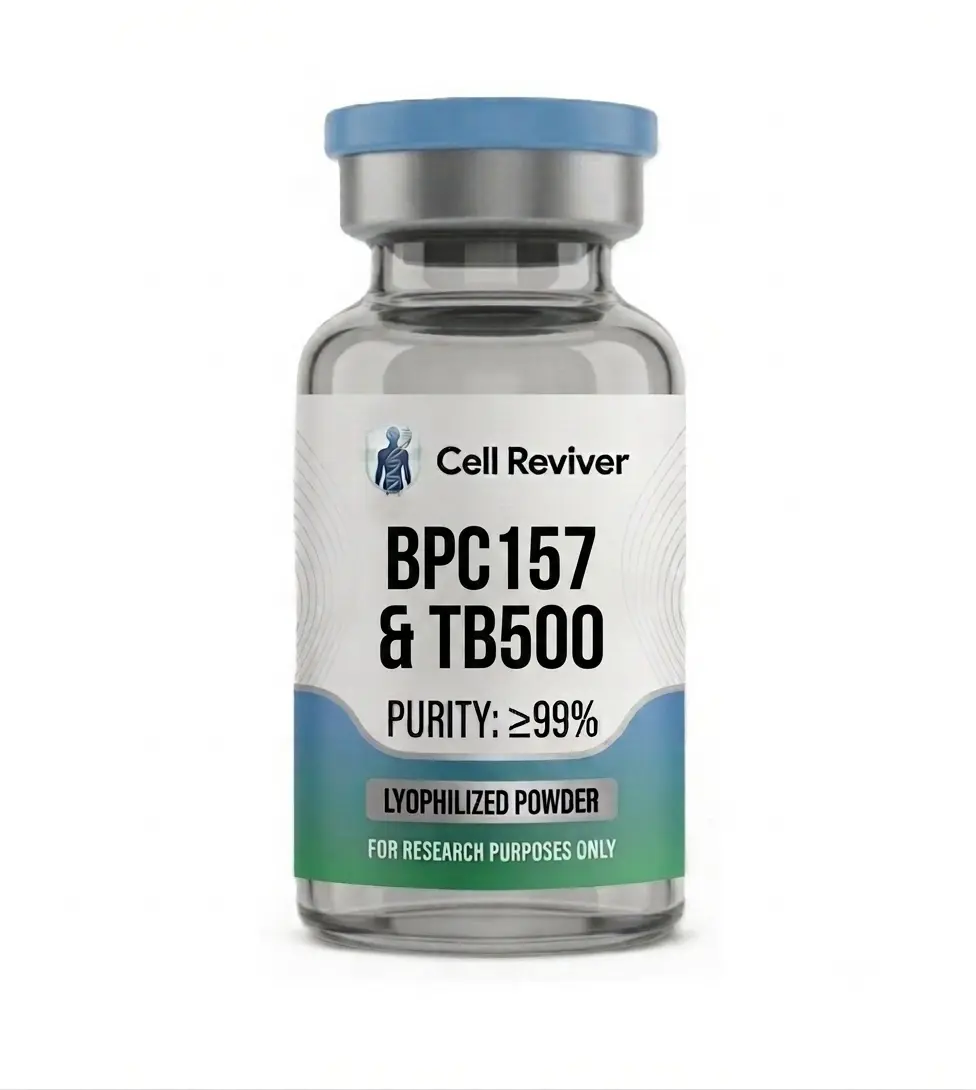
BPC157 + TB500 Blend Research Information
Synergistic Tissue Repair & Regenerative Blend
Available in 10mg and 20mg
️ Important: This information is for educational and research purposes only. Always consult with a qualified healthcare professional before use.
Contents
What is BPC157 + TB500 Blend?
BPC157 + TB500 Blend is a synergistic combination of two powerful regenerative peptides designed for tissue repair and healing research:
- • BPC-157 (Body Protection Compound-157) – A 15-amino acid peptide that promotes angiogenesis, enhances fibroblast proliferation, and protects gastric mucosa
- • TB-500 (Thymosin Beta-4 Fragment) – A 17-amino acid peptide that promotes cell migration, proliferation, and tissue repair through actin regulation
This blend is available in two formulations:
- • 10mg Blend: TB500 5mg + BPC157 5mg = 10mg total
- • 20mg Blend: TB500 10mg + BPC157 10mg = 20mg total
How BPC157 + TB500 Blend Works
This blend combines two distinct but complementary mechanisms of action:
BPC-157
Promotes angiogenesis, enhances growth hormone receptor expression, reduces inflammatory cytokines while promoting cell growth pathways
TB-500
Binds to G-actin, promoting cell migration, proliferation, stimulates VEGF signaling and new blood vessel formation
Together, these peptides provide comprehensive tissue repair and regenerative support through complementary pathways.
Research Applications
Tissue Repair
Synergistic effect on wound healing and tissue regeneration across multiple tissue types
Musculoskeletal
Healing of tendons, ligaments, muscles, and bony injuries
Regenerative Medicine
Researching the regenerative potential of peptide combinations
Gastrointestinal
Promotes mucosal protection and healing of GI ulcers and inflammatory conditions
Clinical Studies
BPC-157 Research
- In a pilot study, 10 of 12 patients (83.3%) with interstitial cystitis had complete resolution of symptoms after one treatment of 10mg BPC-157
- Systematic review showed BPC-157 improved functional, structural, and biomechanical outcomes in muscle, tendon, ligament, and bony injuries
- In a retrospective study, 7 of 12 patients with chronic knee pain reported relief for >6 months following intraarticular BPC-157 injection
TB-500 Research
- Phase 1 safety study demonstrated TB-500 was well tolerated with no dose-limiting toxicities or serious adverse events
- In dermal wound models, TB-500 showed 42% improvement in re-epithelialization at Day 4 and 61% improvement at Day 7
- Phase 2 dry eye disease trial showed 35% reduction in ocular discomfort and 59% reduction in corneal staining
Synergistic Effects
The combination of BPC-157 and TB-500 provides complementary healing pathways:
- BPC-157 promotes angiogenesis and reduces inflammation
- TB-500 promotes cell migration and proliferation
- Together, they enhance overall tissue repair and regeneration
Interactive Dosing Guide
Select your blend size and dose to see the corresponding volume, clicks, dosing frequency, and how many doses per pen/vial:
Step 1: Select Your Blend Size
Step 2: Select Your Dose
Blend Size
10mg Blend
Selected Dose
0.25 mg
Doses per Pen
40 doses
Pen Clicks
7.5 clicks
Volume
0.075 mL
Protocol Level
Level 1
Recommended Schedule
1-2x daily - Loading Phase (Weeks 1-4)
Do not change your dose unless advised by a qualified professional.
Protocol Level Summary
Typical dosing protocols: 250-500 µg twice daily (500-1000 µg total).
Protocol Level
Target Dose
Frequency
10mg Clicks
20mg Clicks
Who It's For
Level 1
0.25 mg
1-2x daily
7.5 clicks
3.75 clicks
New users, first 4 weeks
Level 2
0.5 mg
1-2x daily
15 clicks
7.5 clicks
After 4 weeks, maintenance
Level 3
0.75 mg
1-2x daily
22.5 clicks
11.25 clicks
If more response needed
Level 4
1 mg
1-2x daily
30 clicks
15 clicks
Experienced users only
Do not change your dose unless advised by a qualified professional.
Vial Users (Insulin Syringe)
Add 3mL of bacteriostatic water to your freeze-dried vial and mix gently. After reconstitution, use the table below to draw your dose:
Vial Size
10mg vial with 3mL bac water
Dose
10mg Vial Units
20mg Vial Units
Protocol Level
0.25 mg
7.5 units
3.75 units
Level 1
0.5 mg
15 units
7.5 units
Level 2
0.75 mg
22.5 units
11.25 units
Level 3
1 mg
30 units
15 units
Level 4
Always use a new sterile needle and syringe for each injection.
️ Safety & Precautions
Do not use if you:
- Are allergic to any of the peptides
- Are pregnant or breastfeeding
- Are on blood thinners or immunosuppressants (consult a provider first)
Common side effects:
- Mild injection site reactions
- Initial fatigue or mild headache
- Digestive upset when taken orally
️ Warning: Both BPC-157 and TB-500 are If you experience severe allergic reactions, difficulty breathing, or signs of anaphylaxis, seek immediate medical help.
References
- Lee E, Walker C, Ayadi B. Effect of BPC-157 on Symptoms in Patients with Interstitial Cystitis: A Pilot Study. Alternative Therapies in Health and Medicine. 2024;30(10):12.
- Emerging Use of BPC-157 in Orthopaedic Sports Medicine: A Systematic Review. Sage Journals. 2025.
- Vasireddi N, Vasireddi N, Vasireddi SS. Oral Peptide BPC-157—An Emerging Adjunct to Gastrointestinal Therapies? A Systematic Review. American Journal of Gastroenterology. 2025;120(10S2):S174.
- TB-500 Research Overview. AMD Alliance. 2026.
- TB-500 Acetate: Mechanism of Action in Tissue Regeneration. Benchchem. 2025.
- Józwiak M, Bauer M, Kamysz W, Kleczkowska P. Multifunctionality and Possible Medical Application of the BPC 157 Peptide—Literature and Patent Review. Pharmaceuticals. 2025;18(2):185.
This information is for educational and research purposes only. Always consult with a qualified healthcare professional.
Last updated: July 2026
Interactive Dosing Guide
Select your blend size and dose to see the corresponding volume, clicks, dosing frequency, and how many doses per pen/vial:
Step 1: Select Your Blend Size
Step 2: Select Your Dose
Blend Size
10mg Blend
Selected Dose
0.25 mg
Doses per Pen
40 doses
Pen Clicks
7.5 clicks
Volume
0.075 mL
Protocol Level
Level 1
Recommended Schedule
1-2x daily - Loading Phase (Weeks 1-4)
Do not change your dose unless advised by a qualified professional.
Protocol Level Summary
Typical dosing protocols: 250-500 µg twice daily (500-1000 µg total).
Protocol Level
Target Dose
Frequency
10mg Clicks
20mg Clicks
Who It's For
Level 1
0.25 mg
1-2x daily
7.5 clicks
3.75 clicks
New users, first 4 weeks
Level 2
0.5 mg
1-2x daily
15 clicks
7.5 clicks
After 4 weeks, maintenance
Level 3
0.75 mg
1-2x daily
22.5 clicks
11.25 clicks
If more response needed
Level 4
1 mg
1-2x daily
30 clicks
15 clicks
Experienced users only
Do not change your dose unless advised by a qualified professional.
Vial Users (Insulin Syringe)
Add 3mL of bacteriostatic water to your freeze-dried vial and mix gently. After reconstitution, use the table below to draw your dose:
Vial Size
10mg vial with 3mL bac water
Dose
10mg Vial Units
20mg Vial Units
Protocol Level
0.25 mg
7.5 units
3.75 units
Level 1
0.5 mg
15 units
7.5 units
Level 2
0.75 mg
22.5 units
11.25 units
Level 3
1 mg
30 units
15 units
Level 4
Always use a new sterile needle and syringe for each injection.
️ Safety & Precautions
Do not use if you:
- Are allergic to any of the peptides
- Are pregnant or breastfeeding
- Are on blood thinners or immunosuppressants (consult a provider first)
Common side effects:
- Mild injection site reactions
- Initial fatigue or mild headache
- Digestive upset when taken orally
️ Warning: Both BPC-157 and TB-500 are If you experience severe allergic reactions, difficulty breathing, or signs of anaphylaxis, seek immediate medical help.
References
- Lee E, Walker C, Ayadi B. Effect of BPC-157 on Symptoms in Patients with Interstitial Cystitis: A Pilot Study. Alternative Therapies in Health and Medicine. 2024;30(10):12.
- Emerging Use of BPC-157 in Orthopaedic Sports Medicine: A Systematic Review. Sage Journals. 2025.
- Vasireddi N, Vasireddi N, Vasireddi SS. Oral Peptide BPC-157—An Emerging Adjunct to Gastrointestinal Therapies? A Systematic Review. American Journal of Gastroenterology. 2025;120(10S2):S174.
- TB-500 Research Overview. AMD Alliance. 2026.
- TB-500 Acetate: Mechanism of Action in Tissue Regeneration. Benchchem. 2025.
- Józwiak M, Bauer M, Kamysz W, Kleczkowska P. Multifunctionality and Possible Medical Application of the BPC 157 Peptide—Literature and Patent Review. Pharmaceuticals. 2025;18(2):185.
This information is for educational and research purposes only. Always consult with a qualified healthcare professional.
Last updated: July 2026
Interactive Dosing Guide
Select your blend size and dose to see the corresponding volume, clicks, dosing frequency, and how many doses per pen/vial:
Step 1: Select Your Blend Size
Step 2: Select Your Dose
Blend Size
10mg Blend
Selected Dose
0.25 mg
Doses per Pen
40 doses
Pen Clicks
7.5 clicks
Volume
0.075 mL
Protocol Level
Level 1
Recommended Schedule
1-2x daily - Loading Phase (Weeks 1-4)
Do not change your dose unless advised by a qualified professional.
Protocol Level Summary
Typical dosing protocols: 250-500 µg twice daily (500-1000 µg total).
| Protocol Level | Target Dose | Frequency | 10mg Clicks | 20mg Clicks | Who It's For |
|---|---|---|---|---|---|
| Level 1 | 0.25 mg | 1-2x daily | 7.5 clicks | 3.75 clicks | New users, first 4 weeks |
| Level 2 | 0.5 mg | 1-2x daily | 15 clicks | 7.5 clicks | After 4 weeks, maintenance |
| Level 3 | 0.75 mg | 1-2x daily | 22.5 clicks | 11.25 clicks | If more response needed |
| Level 4 | 1 mg | 1-2x daily | 30 clicks | 15 clicks | Experienced users only |
Do not change your dose unless advised by a qualified professional.
Vial Users (Insulin Syringe)
Add 3mL of bacteriostatic water to your freeze-dried vial and mix gently. After reconstitution, use the table below to draw your dose:
Vial Size
10mg vial with 3mL bac water
| Dose | 10mg Vial Units | 20mg Vial Units | Protocol Level |
|---|---|---|---|
| 0.25 mg | 7.5 units | 3.75 units | Level 1 |
| 0.5 mg | 15 units | 7.5 units | Level 2 |
| 0.75 mg | 22.5 units | 11.25 units | Level 3 |
| 1 mg | 30 units | 15 units | Level 4 |
Always use a new sterile needle and syringe for each injection.
️ Safety & Precautions
Do not use if you:
- Are allergic to any of the peptides
- Are pregnant or breastfeeding
- Are on blood thinners or immunosuppressants (consult a provider first)
Common side effects:
- Mild injection site reactions
- Initial fatigue or mild headache
- Digestive upset when taken orally
️ Warning: Both BPC-157 and TB-500 are If you experience severe allergic reactions, difficulty breathing, or signs of anaphylaxis, seek immediate medical help.
References
- Lee E, Walker C, Ayadi B. Effect of BPC-157 on Symptoms in Patients with Interstitial Cystitis: A Pilot Study. Alternative Therapies in Health and Medicine. 2024;30(10):12.
- Emerging Use of BPC-157 in Orthopaedic Sports Medicine: A Systematic Review. Sage Journals. 2025.
- Vasireddi N, Vasireddi N, Vasireddi SS. Oral Peptide BPC-157—An Emerging Adjunct to Gastrointestinal Therapies? A Systematic Review. American Journal of Gastroenterology. 2025;120(10S2):S174.
- TB-500 Research Overview. AMD Alliance. 2026.
- TB-500 Acetate: Mechanism of Action in Tissue Regeneration. Benchchem. 2025.
- Józwiak M, Bauer M, Kamysz W, Kleczkowska P. Multifunctionality and Possible Medical Application of the BPC 157 Peptide—Literature and Patent Review. Pharmaceuticals. 2025;18(2):185.
This information is for educational and research purposes only. Always consult with a qualified healthcare professional.
Last updated: July 2026
⚠️ FOR RESEARCH PURPOSES ONLY